

8 min read
Flu Season Is Ramping Up: What After-Hours Call Volume Looks Like for Medical Practices
By: Shaun Grubert on Oct 27, 2026, 7:00:00 AM
Introduction
The CDC confirms it every year: flu season activity typically picks up in October, peaks between December and February, and can extend through May. For medical practices, this isn't abstract epidemiology — it's a predictable surge in patient calls that arrives like clockwork.
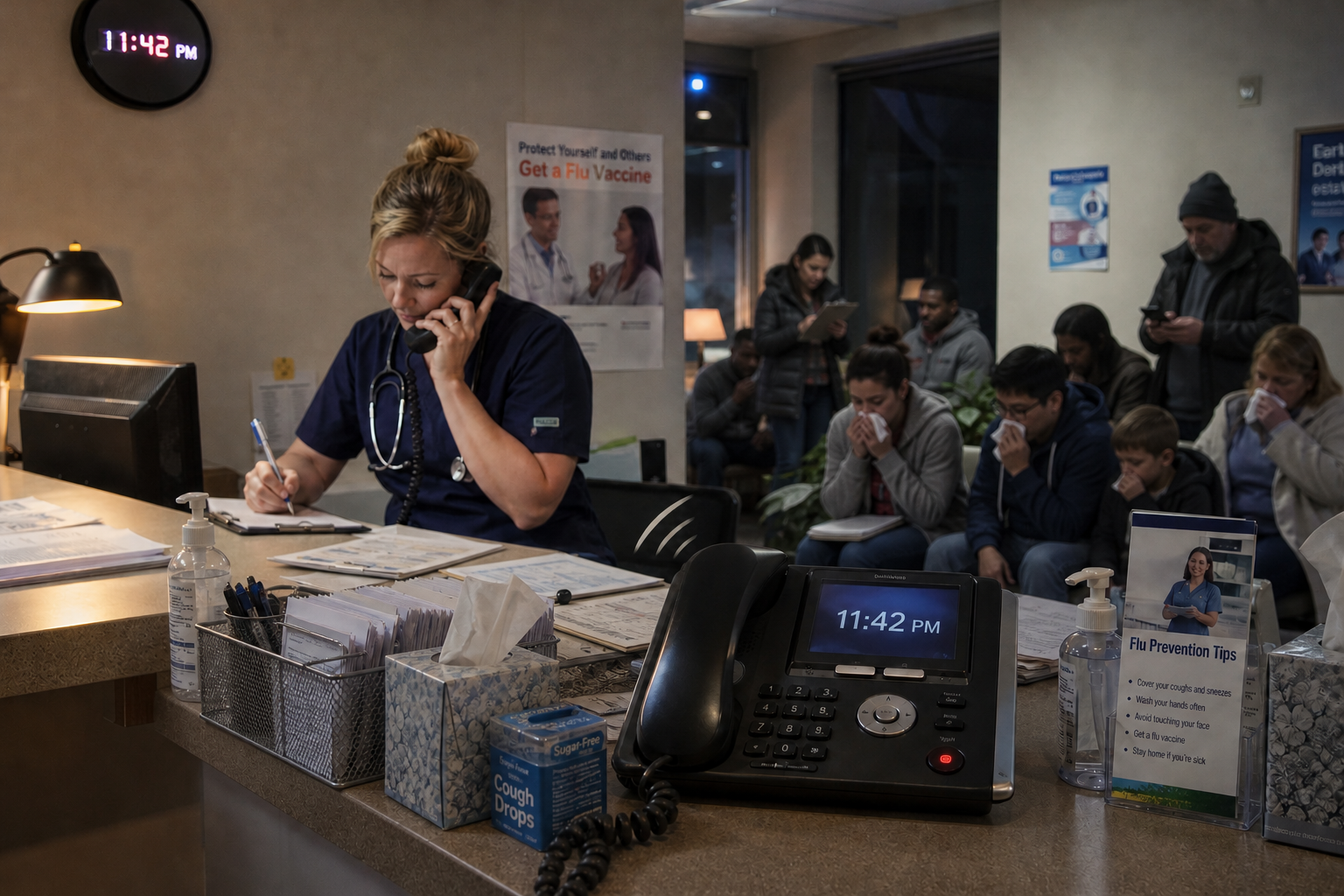
Since early October, your office phones have been getting busier. Patients calling with symptoms. Patients asking whether to get vaccinated. Patients trying to schedule appointments while providers are running behind on respiratory cases. And all of that call volume arrives 24 hours a day — most of it outside your standard 9-to-5 staffing hours.
The practices that are covered for this surge planned it before the first busy night, not in the middle of the surge when the phones are already ringing off the hook.
This article is about getting your after-hours coverage ready now, before the heaviest weeks arrive. It's about understanding what flu season actually looks like in call volume, what kinds of calls arrive when, and how to make sure the person answering your phone at 11 PM in January knows how to triage a patient who thinks they have the flu.
Why Flu Season Calls Are Different from Regular After-Hours Volume
The baseline for after-hours medical calls is real and substantial: a large share of patient calls come in outside standard staffing hours, before 8 AM or after 5 PM. Medical practices with after-hours answering services already know this.
But flu season changes the baseline.
During the peak months (December through February), that after-hours volume doesn't just increase — it changes in character. You get:
- Symptom inquiries. Patients calling at 10 PM asking whether their symptoms sound like the flu or something else. This is a triage call, not a scheduling request, and it requires a trained ear.
- Urgent appointment requests. Patients who are sick now and need to be seen tomorrow, not in two weeks. These calls have to reach the provider quickly; they can't sit in a voicemail queue until morning.
- Medication refill requests tied to acute illness. A patient on a maintenance medication calls because they want to refill it before the flu hits, or they're calling because they just got sick and their inhaler supply is low. These calls need routing clarity — do they go to the pharmacy, the nurse line, or the doctor?
- Follow-up calls from patients already being treated. A patient on antibiotics calls because they're not improving. A patient on cough suppressants calls because the cough got worse. These aren't new cases; they're complications of active cases.
- Worried relatives calling on behalf of patients. A daughter calls about her elderly father's symptoms. A spouse calls about their partner's fever that won't break. The person answering the phone has to gather information from someone who isn't the patient and relay it accurately.
Each of these call types carries different routing needs. Each one can compound if it's not triaged correctly. And each one arrives at 11 PM, 2 AM, or 7 AM when your office is closed.
The AMC Flu-Season Call Preparation Framework
To handle flu season call volume correctly, a medical practice needs four elements in place before the peak weeks (December through February) arrive:
1. Clear Routing for Symptom-Triage Calls
Not every after-hours call can be routed to the on-call provider. Some calls need to stop with the answering service operator.
A patient calling at midnight with a question like "does this sound like the flu?" doesn't necessarily need the doctor. They need a trained listener who can gather symptoms, ask clarifying questions, and either:
- Direct them to an urgent-care facility if the situation warrants it
- Tell them to call back in the morning for an appointment if it's stable
- Escalate to the on-call provider if the situation is acutely serious (difficulty breathing, chest pain, signs of dehydration in a young child)
Your answering service should have symptom-screening criteria for flu-like illness in your account script. This isn't medical advice — it's structured listening that prevents unnecessary midnight escalations and catches the ones that truly matter.
2. Explicit On-Call Availability and Escalation Rules
The on-call provider during flu season is busier than usual. They need to know in advance which calls will be escalated to them and which won't.
This means establishing clear escalation criteria with your on-call provider before the season starts:
- Symptoms that always escalate (difficulty breathing, chest pain, severe dehydration in a patient under 5)
- Symptoms that escalate only if they're worsening (cough + fever if the fever is above 104°F and climbing)
- Situations that go to urgent care instead (anything that sounds like possible sepsis, stroke symptoms, or head injury)
When the on-call provider knows these criteria in advance, they don't have to make judgment calls at 2 AM. The protocol makes the call.
3. Coordination with Urgent-Care and ER Referrals
Your after-hours answering service can't treat patients, but they can direct them. During flu season, some callers need to know where urgent care is, what the ER wait time looks like, or whether an urgent-care center can handle a specific symptom.
Before the peak weeks, check in with nearby urgent-care facilities and establish whether your answering service can provide their hours and location. This prevents your operators from saying "you need urgent care" without being able to direct the patient to one.
4. Staffing Adjustments for Peak Volume
If your answering service knows that flu season means a noticeable increase in call volume, they can staff for it. This might mean:
- Adding an extra operator to your account from now through February
- Adjusting their queue so your practice's calls get priority on the busiest nights
- Scheduling your service's most experienced operators on your account during the peak weeks
Your answering service should have this conversation with you now, not in December.
The Most Common Flu-Season After-Hours Mistakes
The practices we work with that handle flu season well have one thing in common: they prepared. The ones that don't prepare usually make one of these mistakes:
Mistake 1: Treating all symptom calls as urgent. A caller asks "Is this the flu?" and the operator, uncertain about the answer, routes it to the on-call provider. The on-call provider is woken at 3 AM for a patient who has a runny nose. Within a few weeks, this pattern burns out the on-call team and makes them reluctant to take calls. Solution: train your answering service to gather symptoms and use clear criteria for when to escalate.
Mistake 2: Voicemail backup. The peak nights in early January are so busy that calls hit a full voicemail box. Patients can't leave messages. Patients who can't get through call the ER instead. Your practice loses control of the intake. Solution: increase your answering service staffing in December and January; plan for the surge, don't hope to absorb it with the same staffing.
Mistake 3: No clarity on medication refills during flu season. A patient calls asking to refill their maintenance medication and mentions they're "preparing for the flu season." Does this call go to the pharmacy? The nurse? The provider? If the routing isn't clear, the call gets escalated unnecessarily or it sits in a queue. Solution: establish explicit routing for medication refill requests with a note about seasonal increases.
Mistake 4: Treating the answering service as transactional. "Just take a message and I'll call them back" works fine for routine daytime calls. It fails during flu season, when the patient calling at 11 PM needs immediate routing, not a callback in 12 hours. Solution: build triage capability into your after-hours service before the season arrives.
When Does Flu Season Increase After-Hours Medical Calls?
The CDC's data is clear: flu activity picks up in October and peaks between December and February. For medical practices, this means:
- October: Calls start rising — vaccination requests, early-season patients asking if they have the flu, appointment scheduling as practices prepare
- November (just ahead): Call volume increases noticeably; patients who procrastinated on flu shots start calling; some flu cases arrive early (the virus doesn't wait for December)
- December-February: Peak volume. This is when call volume surges most noticeably, appointment slots fill up, and after-hours lines stay busier than any other time of year
- March onward: Volume declines as flu activity tapers, though scattered cases persist through May
For practices in colder climates or with high elderly populations, the peak often extends through March.
Frequently Asked Questions About Flu Season After-Hours Coverage
When does flu season increase after-hours medical calls?
The CDC confirms that flu activity typically picks up in October and peaks between December and February. For medical practices, this means after-hours call volume begins rising noticeably in October and remains elevated through February. The busiest nights are typically mid-December through early February. By March, volume begins to decline, though scattered cases can persist through May.
Do many flu-season calls arrive after-hours for medical practices?
A large share of patient calls come in outside standard staffing hours even in a normal month. During flu season, the proportion of after-hours calls often increases further because many patients call in evenings with new symptoms or escalating concerns. Additionally, the total call volume surges during flu season, making the absolute number of after-hours calls significantly higher than baseline.
What should an answering service ask a patient who calls with flu-like symptoms after-hours?
A trained symptom-triage call captures: description of symptoms (fever, cough, body aches, sore throat); current temperature if the patient knows it; duration of symptoms; any difficulty breathing or chest pain; whether it sounds like it's worsening or stable. The operator then uses clear criteria to decide: direct to urgent care, escalate to the on-call provider, or advise the patient to call back for an appointment in the morning. Each practice's criteria will vary based on the provider's protocols.
How should I prepare my practice for increased after-hours calls during flu season?
Four steps, ideally before the December peak: (1) Establish symptom-triage criteria with your on-call provider and give them to your answering service. (2) Create an explicit escalation map — which symptoms go to the provider, which go to urgent care. (3) Coordinate with nearby urgent-care facilities so your answering service can direct patients there when appropriate. (4) Confirm with your answering service that they can staff for the expected surge from now through February — you may need an additional operator during peak weeks.
What is the difference between a symptom-screening call and medical advice?
Symptom screening is structured listening — the operator gathers information (fever, cough, duration, severity) and applies a pre-established protocol to route the patient correctly. Medical advice would be the operator saying "you have the flu" or "you need antibiotics." Your answering service should be doing the former, never the latter. The distinction matters legally and clinically. Your on-call provider can make the diagnosis; your answering service can ask the questions that help route the call.
Closing
Flu season isn't a surprise. It arrives on the CDC's predicted schedule every year. The only variable is whether your practice is ready for it.
Being ready means more than hoping your answering service can handle the surge. It means having prepared protocols, explicit routing rules, and staffing adjustments in place before the peak weeks. It means training your answering service on the call types that arrive in flu season and trusting them to triage correctly.
The practices we work with that handle flu season well have one thing in common: they planned it before the first busy night, not in the middle of the surge. That preparation is the difference between an answering service that keeps your after-hours line working smoothly through the winter and one that becomes a bottleneck.
If you want to walk through how your current after-hours setup maps to flu season readiness — or how to build a triage protocol that works for your practice — we're glad to have that conversation. A well-prepared after-hours line through flu season is worth the planning investment many times over.
A Message Center is a US-based, family-owned live telephone answering service — answering since 1962. HIPAA-compliant answering for medical practices, BAA available for review. HIPAA-trained operators working from each practice's own protocols, 24/7/365. People Answering People.